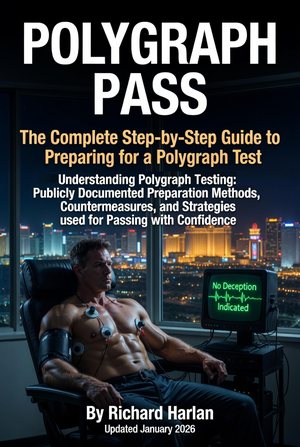
Polygraph Pass by Richard Harlan — book coverBuy on Amazon →Click cover to buy on Amazon

Polygraph Pass

The Complete Step-by-Step Guide to Preparing for a Polygraph Test

Polygraph Pass by Richard Harlan — the complete step-by-step guide to understanding and preparing for a polygraph (lie detector) test, with publicly documented countermeasures and the science on accuracy.

By Richard Harlan·Kindle & Print·English

Understand and prepare for a polygraph (lie detector) test

Polygraph Pass is the complete, step-by-step educational guide to the polygraph — the so-called lie detector. It explains how the instrument works, what it actually measures, the procedural variations you will encounter, and the substantial scientific research questioning its validity as a reliable truth-detection tool.

Built from the National Research Council's landmark 2003 report, declassified CIA and NSA polygraph training documents, and peer-reviewed psychological research, the guide covers publicly documented preparation methods, the physiological theory behind countermeasures, and a plain-language summary of what decades of research conclude about polygraph accuracy.

Inside the guide

  • How a polygraph works — and why the underlying theory is scientifically contested
  • The NRC 2003 report: its key findings, in plain language
  • Publicly documented physiological countermeasures and the research on them
  • Psychological preparation techniques from public sources
  • Question types, test formats and common examiner tactics
  • Legal status and admissibility of polygraph results across jurisdictions

If you are facing a pre-employment screening, a security-clearance interview or simply want to understand whether a lie-detector test can be trusted, this guide gives you the documented facts to prepare with confidence.
What Makes Polygraph Pass Worth Reading

Polygraph Pass does something most books on the subject refuse to do: it takes the instrument seriously enough to examine it honestly. Rather than either defending the polygraph as a truth machine or dismissing it as pseudoscience, Harlan builds the case from the primary record — the National Research Council's 2003 review, declassified federal training material, and the peer-reviewed psychological literature — and lets the evidence land where it lands. The result is a guide that prepares the reader for the room they will actually sit in, while being straight with them about what the machine can and cannot establish.

— Editorial assessment, The Information Station

Key Insights from the Book

Research Depth

Built from the primary record

The spine of the book is the National Research Council's landmark 2003 review — the most authoritative scientific assessment of the polygraph ever produced — supplemented with declassified federal training documents and peer-reviewed psychology. Readers are pointed to the sources rather than asked to take the author's word.

Practical Application

The pre-test interview gets its due

Most of what determines a polygraph outcome happens before the instrument is attached. The guide gives the pre-test interview the weight it deserves, walking through examiner tactics, question construction, and the psychology of the room.

Clarity

Physiology explained without jargon

Blood pressure, respiration, and galvanic skin response are described in plain language, along with the crucial point most coverage omits: none of these signals is unique to deception.

What Makes It Different

It explains why countermeasures work

The book does not present countermeasures as tricks. It explains the physiological theory underneath them — which is inseparable from understanding why the instrument's validity is scientifically contested in the first place.

Scope & Honesty

Clear about the limits of the evidence

The guide is candid that polygraph accuracy research is thin and methodologically weak, and it says so rather than overselling certainty in either direction.

Practical Application

Question formats mapped out

Relevant/irrelevant, comparison question, and concealed information formats are each broken down, so a reader can recognise the structure of the test they are actually given.

Legal Context

Admissibility covered by jurisdiction

A plain summary of where polygraph results carry legal weight and where they do not — which varies considerably and is widely misunderstood.

Who It's For

Written for the person facing the test

Pre-employment screening, security clearance, and internal investigations are the real-world contexts here, and the book is organised around them rather than around abstract theory.

Read the book? Your honest review helps other readers find it.

All Editorial Reviews →

Frequently Asked Questions

Can you beat a polygraph test?

The scientific literature is clear that polygraph results can be influenced by countermeasures. The 2003 National Research Council report explicitly noted that some countermeasures can be learned quickly and may produce innocent-seeming responses. Polygraph Pass documents what the public research says about these methods and why they work — which is inseparable from understanding why the instrument's validity is scientifically contested in the first place.

How accurate is a lie detector test?

Far less accurate than popular belief suggests. The National Research Council found the evidence base for polygraph validity to be scanty and scientifically weak, and concluded that in realistic screening scenarios the false-positive rate is high enough to implicate large numbers of innocent people. The guide summarises those findings in plain language.

Are polygraph results admissible in court?

In most jurisdictions, no — or only under narrow conditions. Admissibility varies significantly by country and by state or province. The guide covers the legal status of polygraph evidence across jurisdictions so you know where you stand.

What actually happens during a polygraph examination?

A polygraph measures physiological signals — typically blood pressure, respiration, and galvanic skin response — while an examiner asks a structured sequence of questions. The guide walks through the full process step by step: the pre-test interview, question formats, examiner tactics, and how results are scored.

How do I prepare for a pre-employment or security-clearance polygraph?

The guide covers every publicly documented preparation method, the psychology of the pre-test interview, and the physiological theory behind how the test is supposed to work. Understanding the instrument is the foundation of preparing for it with confidence.