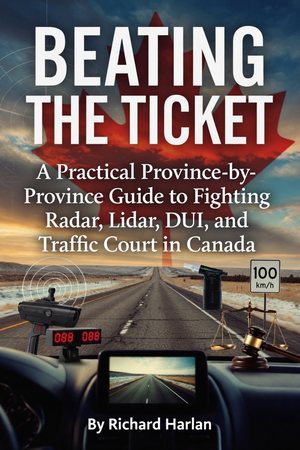
Beating the Ticket by Richard Harlan — book coverBuy on Amazon →Click cover to buy on Amazon

Beating the Ticket

A Practical Province-by-Province Guide to Fighting Radar, Lidar, DUI & Traffic Court in Canada

Beating the Ticket by Richard Harlan — a practical, province-by-province Canadian guide to fighting radar, lidar, DUI and traffic-court charges, and disputing tickets with confidence.

By Richard Harlan·Kindle & Print·English

Fight radar, lidar, DUI and traffic-court charges across Canada

Beating the Ticket is a practical, province-by-province Canadian guide to fighting traffic tickets — from speeding and radar/lidar charges to distracted-driving and impaired-driving (DUI) allegations — and to representing yourself effectively in traffic court.

It demystifies the technology and the process: how police radar and lidar actually work and where they can be challenged, how disclosure requests work, how to read the officer's notes, and how to build and present a defence. It is written for ordinary drivers, not lawyers, with clear procedures for each province and territory.

Inside the guide

  • How radar and lidar speed measurement works — and its documented weaknesses
  • Requesting and using disclosure to find defects in the Crown's case
  • Province-by-province procedures, deadlines and forms
  • Cross-examining the officer and challenging device calibration and operator training
  • Distracted-driving and careless-driving defence strategies
  • Understanding DUI / impaired-driving charges and when to get a lawyer

Whether you want to beat a speeding ticket, fight a radar charge or simply understand your rights on the roadside and in the courtroom, this guide gives you a clear, step-by-step playbook for disputing a ticket with confidence.
What Makes Beating the Ticket Worth Reading

The premise of Beating the Ticket is that most drivers lose before they begin — not in court, but at the kitchen table, by paying the fine without ever seeing the evidence. Harlan's answer is procedural rather than rhetorical: request disclosure, read the officer's notes, check the calibration records, and find out whether the case against you is actually complete. The province-by-province structure is what makes it usable, because traffic procedure is provincial and generic advice fails precisely on that point. Notably, the book tells readers when to stop self-representing and hire a lawyer — a line most guides in this genre blur.

— Editorial assessment, The Information Station

Key Insights from the Book

What Makes It Different

Disclosure is the whole strategy

The book's central insight is that traffic cases are won by reading the file, not by clever argument. Disclosure — the officer's notes, calibration records, operator certification — is where the weaknesses become visible.

Coverage

Genuinely province-by-province

Deadlines, forms, dispute options and the office you write to differ across Canada. What works in Ontario does not work in Alberta, and the book is structured around that reality.

Technical Clarity

Radar and lidar explained honestly

The Doppler principle, beam width, the cosine effect, and lidar sweep error are explained accurately — including where each favours the driver and where it does not.

Practical Application

Cross-examining the officer

Concrete guidance on questioning device calibration, operator training, and target identification — the three links every speed reading depends on.

Scope & Honesty

Tells you when to get a lawyer

On impaired driving the book is unambiguous: the stakes are criminal, and it says to retain counsel rather than self-represent.

Practical Application

The real cost of pleading guilty

Fines are set to make contesting feel not worth it. The book surfaces the deferred cost — demerit points and insurance premiums compounding over years — that makes the calculation look very different.

Who It's For

Written for the self-represented driver

No legal background assumed. The procedures are laid out as steps a non-lawyer can actually follow.

Coverage

Beyond speeding

Distracted driving, careless driving and impaired-driving charges each get treatment, rather than the book being a speeding-ticket manual with a broad title.

Read the book? Your honest review helps other readers find it.

All Editorial Reviews →

Frequently Asked Questions

Can you actually fight a speeding ticket and win?

Yes — tickets are dismissed routinely, and often on procedural or evidentiary grounds rather than on the question of whether you were speeding. Beating the Ticket shows you how to request disclosure, identify defects in the Crown's case, and present a defence in traffic court as a self-represented driver.

How do police radar and lidar actually work?

Radar measures speed using the Doppler shift of a reflected radio signal; lidar uses timed pulses of infrared light against a much narrower target. Both have documented limitations — and both depend on correct calibration, correct operator training, and correct deployment. The guide explains the technology and exactly where each of those dependencies can be challenged.

What is disclosure and why does it matter?

Disclosure is the evidence the prosecution must provide you — typically the officer's notes, device calibration records, and operator certification. It is the single most powerful tool available to a self-represented driver, because it is where the weaknesses in the case become visible. The guide explains how to request it and how to read it.

Does this guide cover every province?

Yes — it is organised province by province, because traffic procedure, deadlines, forms, and dispute options differ meaningfully across Canada. What works in Ontario is not what works in Alberta or British Columbia.

Should I get a lawyer for a DUI charge?

For impaired driving, generally yes — the stakes are criminal, not merely financial, and the guide says so plainly. It explains how DUI charges work and what to expect, but it is explicit that a criminal charge warrants qualified legal counsel rather than self-representation.