
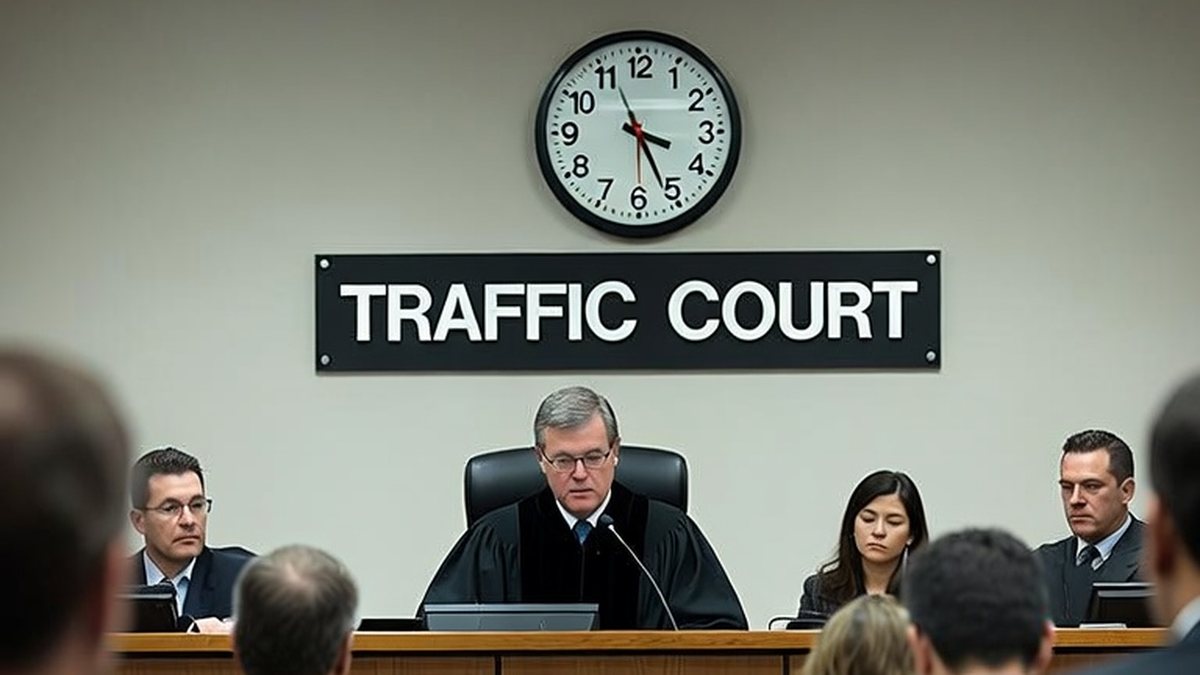
Two beliefs keep most drivers from contesting a ticket. The first is that traffic court is a formal, intimidating, lawyer-infested arena where an ordinary person has no business standing up. The second is that the ticket is a one-time cost, and that the fine on the paper is the price.
Both are usually wrong, and the second one is wrong by an order of magnitude.
What the fine actually costs you
The number printed on the ticket is the smallest part of the bill. The real cost comes in three layers:
- The fine. The visible cost, plus victim surcharges and administrative fees that are typically added on top.
- Demerit points. These accumulate, and accumulation triggers escalating consequences — warning letters, interviews, and eventually suspension. A single conviction can matter far more if it is not the only one on the record.
- Insurance. This is the layer almost nobody prices in, and it is usually the largest by a wide margin. A conviction typically stays on your record for around three years, and insurers price accordingly at each renewal.
Run the arithmetic yourself. If a conviction raises your premium by even a modest monthly amount, multiply it across thirty-six months of renewals. For many drivers, the deferred insurance cost dwarfs the fine several times over — and a second conviction while the first is still on the record can compound the effect sharply.
Fines are set at a level calculated to make contesting feel like more trouble than it is worth. The genuine cost is deferred, invisible at the moment you decide to pay, and considerably larger.
The system does not hide this. It simply relies on you not doing the multiplication.
Pleading guilty by paying
It is worth being explicit about something many drivers do not realise: paying the ticket is a guilty plea. It is not a fee, a settlement, or a way of making the matter go away. It is a conviction, entered by you, with all three layers of cost attached.
What traffic court is actually like
Traffic court is not a criminal trial. In most Canadian jurisdictions, a routine traffic matter is a provincial offence heard in a busy courtroom processing a long list of similar cases. The realities are worth knowing:
- Almost nobody has a lawyer. Self-represented drivers are the norm, not an oddity. Justices of the peace deal with them constantly and are generally accustomed to explaining procedure.
- The room is busy and businesslike. Your matter will likely take minutes, not hours.
- The prosecutor is often willing to discuss resolution before the matter is heard — frequently a reduction to a lesser offence carrying fewer or no demerit points. This alone is a common and legitimate reason to appear.
- The officer must attend. The prosecution's case usually depends on the officer's testimony and notes. Officers have shifts, leave, court conflicts, and competing obligations.
Where cases are actually won
Not with dramatic cross-examination. The realistic paths are procedural and evidentiary:
- Disclosure reveals a gap. Missing calibration records, absent operator certification, or officer's notes too thin to establish how your vehicle was identified and tracked.
- Delay. Matters that take too long to be heard can be challenged on that basis.
- Negotiated resolution. A reduced charge that removes the demerit points — and therefore removes most of the insurance consequence — is a real win even though it is not an acquittal.
- The officer does not attend. It happens, and when it does, the prosecution frequently cannot proceed.
None of these require oratory. They require showing up, having requested disclosure, and having read it.
"What if I fight it and lose?"
This is the question that stops most people, and the honest answer is reassuring in most routine cases: you are generally in a similar position to where you started. The fine may be payable, sometimes with time to pay, and in many jurisdictions there is no realistic prospect of a worse outcome than the offence you were already charged with. Courts do not punish people for exercising the right to be heard.
This asymmetry is the heart of the matter. The downside of contesting a routine ticket is usually modest and bounded. The downside of pleading guilty is three years of insurance consequences you never see itemised anywhere.
A necessary line
Everything above concerns routine provincial traffic offences — speeding, minor moving violations, and the like. It does not apply to impaired driving, dangerous driving, or any criminal charge. Those carry criminal consequences, and the correct step there is to retain a qualified lawyer rather than to self-represent. That distinction is not a formality; it is the most important sentence in this article.
For everything else: request disclosure, read it, and decide with the actual numbers in front of you rather than the ones the ticket wants you to see.
Disclaimer: This article is for educational purposes only and does not constitute legal advice. Traffic law and procedure vary by province and territory. If you are facing a criminal charge such as impaired driving, consult a qualified lawyer.